Come Wednesday night most of my Canadian friends and family will be sitting on the couch eagerly watching tv to see whether the Toronto Blue Jays pull off another win in the fifth game of the baseball World series. I’m somewhat less interested in this (but “go jays go” etcetera). Instead, I’ll be eagerly awaiting the results of the Dutch parliamentary elections. Somewhat unusually – this time I’m not watching to see which party wins the most seats – but rather I’ll be watching to see who comes second – and third.
The Dutch electoral system – a very short explanation
Dutch politics are very fun in my opinion – one reason for this is that Dutch voters have a lot of options. In fact, in the upcoming elections we have 27 (!) parties participating. This includes some gems such as the “pirate party”, a senior’s party, and the (in)famous “party for the animals”, which advocates for the abolishment of intensive animal farming (among other things). Note that not all of these parties will get representation in parliament, in fact the current parliament has “only” 15 parties.
There are some issues with having so many small parties, but for now the key thing to know is that voters have a lot of options and it is extremely unlikely that one party would obtain an outright majority. It’s not impossible – but to my knowledge it has never happened.
Figure 1: Dutch political parties as represented by Simpsons characters
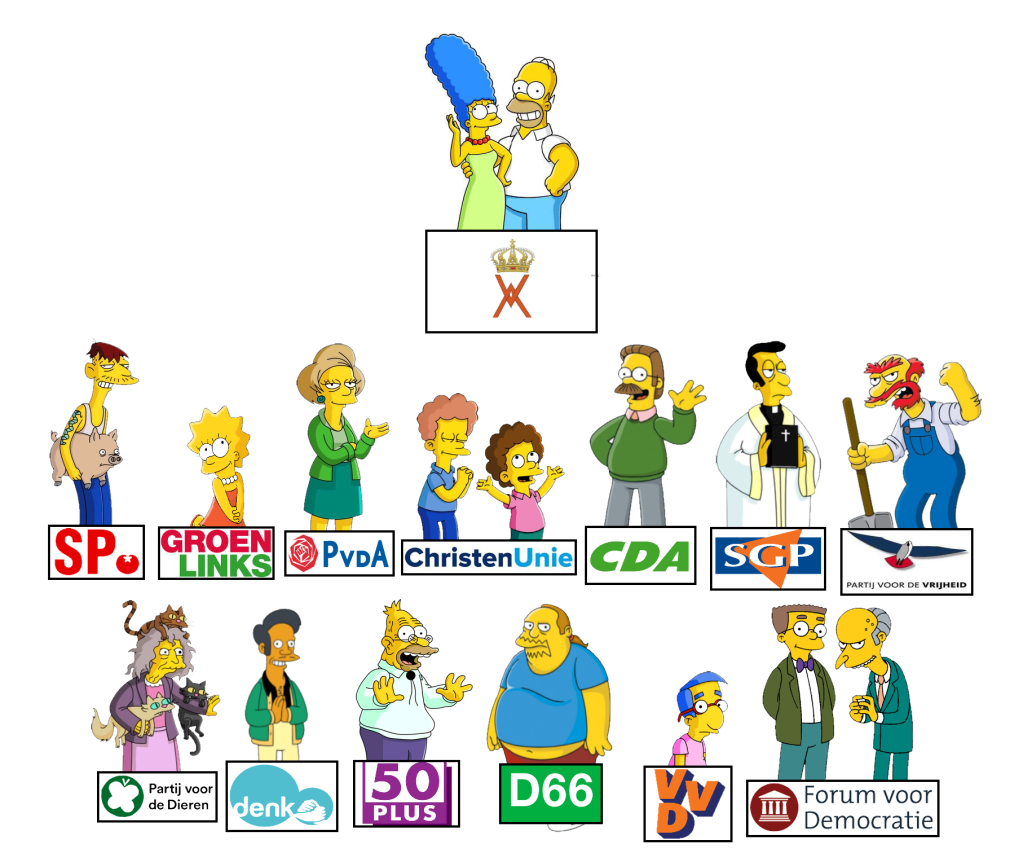
I came across this rather funny image on reddit – I have to admit I don’t know the Simpsons well enough to judge the accuracy but it might give north american readers a sense of the landscape
Second – the Dutch electoral system is pretty simple. The distribution of votes to seats is entirely proportional – and – there are no districts. Instead, the entire country is one single district. What this means in practice is that if a party receives 20% of the votes – it receives 20% of the seats in parliament. There are lots of pros and cons to this (and if you ask me in person I will happily talk about these at length), but so far – easy peasy.
The part where Dutch politics gets complicated is when it’s time to form a government. The lower house of the Dutch parliament has 150 seats and so a party needs 76 seats to form a government. Now, as mentioned, it’s extremely unlikely for one single party to obtain a straight-up majority and so instead, parties need to work together to form a coalition – and this is where things get complicated. Coalition negotiations can take a long time and governments will often consist of 3 or 4 parties who agree to a formal coalition agreement and governing plan.
The 2025 elections
The 2025 elections came about because Geert Wilders, the leader of the “Freedom Party” (PVV), withdrew his support for the incumbent government. The government consisted of a coalition of 4 parties, including Wilders’ own party. Wilders’ party had won the previous elections in November 2023, but unusually he did not become Prime Minister, as the other coalition partners did not agree to this. Instead a non-partisan Prime Minister (Dick Schoof) was appointed. This was an unusual arrangement and it evidently did not last long.
In many ways the main theme of this election has been Wilders himself. Throughout the campaign Wilders’ main message to voters has been to make his party great again (no pun intended). According to Wilders, if his party once again becomes the largest, he will become Prime Minister this time round. A key question for the other parties has been whether they would participate in a hypothetical government with Wilders at the helm.
Throughout the campaign it’s become clear that most parties are not willing to participate in a hypothetical Wilders’ government, and thus chances of Wilders becoming prime minister are slim. For some parties this is a matter of ideology; parties like D66 or GL/PvdA are uncomfortable with Wilders’ platform, particularly when it comes to immigration. Other parties such as CDA and VVD have previously worked with Wilders, but have found the experience rather bruising.
Can you count to 76?
And thus, with one day to go, it seems unlikely that Wilders would actually be able to form a government even if his party gains the most seats (which most polls are predicting). Instead it seems that whomever comes second or maybe even third might hold the keys to power. Which party this will be remains unclear as the most recent polls show three parties (GL/Pvda ; D66 and CDA) neck and neck.
Figure 2: recent opinion polls Dutch elections
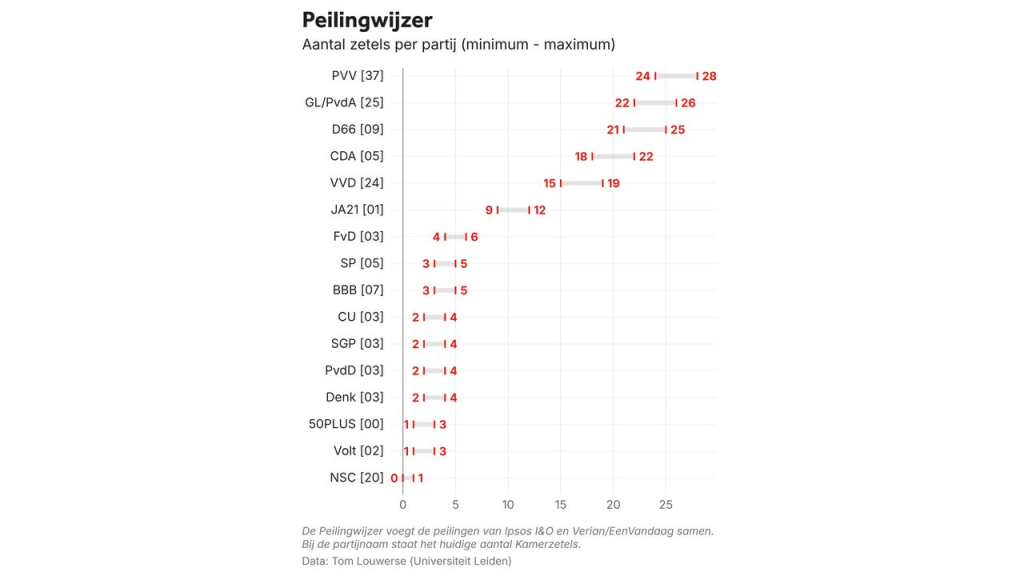
Polls are slippery like eels as the Dutch say (in Dutch this translates to “peilingen zijn als palingen” which has the benefit of alliteration) and more than a third of voters reportedly haven’t made a decision yet as to who to vote for.
In the Danish tv-show Borgen, the main fictional character Birgitte Nyborg leads her small moderate party to a surprising electoral upset. Her party comes in third, but at the end of the show’s second episode, her political friend and confidant Bent tells her: “the only relevant question is who can count to 90?” As it turns out, Nyborg can count to 90: she finds support for a majority and becomes the first (fictional) female prime minister of Denmark.
The main question many Dutch parties will be asking themselves on Thursday morning will therefore be “who can count to 76?”
 Roosmarijn de Geus, PhD
Leave a comment